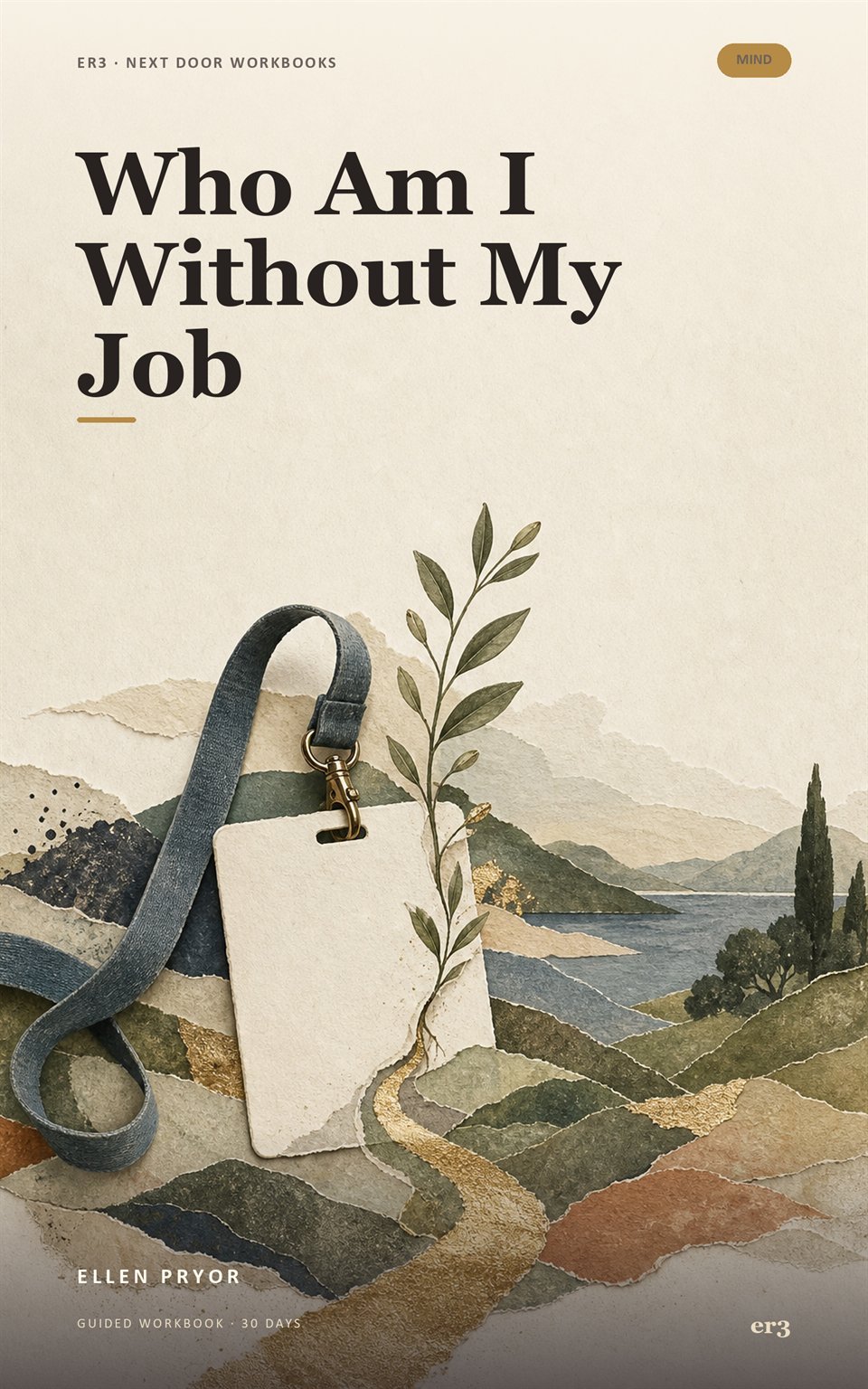
The card is still on the fridge. Everyone at the office signed it — thirty-odd names, some in the careful hand of people who barely knew me, one in the corner that just says "the place won't be the same, boss." It's held up by a magnet shaped like a lemon. I read it more often than I'd admit. It is, if I'm honest, the last piece of paper in this house that has my old life written on it.
For thirty-one years I knew who I was by seven forty-five in the morning. I ran a department of nineteen people. I signed off on things. When something broke, the phone in my hand was the phone that fixed it. I was not a woman who wondered what to do with a day — a day was a thing that happened to me, full to the brim, whether I liked it or not.
Then there was a lunch, and a cake, and a speech where my boss's boss got my start date wrong by a year and nobody corrected him. There was the card. And there was a Friday afternoon where I carried a box to my car, and that was that. The team I'd built — I keep saying the team, present tense, like it's still mine — went back to work on Monday without me, and I do not think the building noticed the difference by Wednesday.
The first Tuesday is the one I remember. Not the first Monday — Monday I slept in on purpose, felt clever about it. Tuesday I woke at five-forty out of thirty-one years of habit, wide awake, and had absolutely nowhere to put it. By noon I was still in my robe. My coffee had gone cold twice and I'd reheated it twice, which felt like an accomplishment and also like the saddest thing I had ever done. My husband came through the kitchen looking for his keys, kissed the top of my head, and left, and it struck me standing there that I had become invisible in my own house. Nobody in the world needed anything from me. I would not have believed how much that hollows you out until it was mine.
So I did what people like me do. I made it a project. I reorganized every closet. I signed up for a watercolor class and quit after the second week because a woman there kept calling it "our little artistic journey" and I could not do it. I met former colleagues for lunches that ran out of conversation by the time the plates came, because the only thing we'd ever truly shared was a building I no longer walked into.
The phone was the cruelest part. Not a dramatic silence — just fewer pings, and then fewer, until a whole day would pass with nothing on the screen but the weather. I'd spent three decades wishing people would stop needing me for five minutes. It turns out being needed and being useful had grown so tangled together in me that when one went, the other went with it, and I hadn't known they were separate things at all.
I keep saying the team, present tense, like it's still mine.
What broke the loop wasn't grand. There was a flyer at the library — they needed people to reshelve returns two mornings a week, no experience, just reliability. I signed up mostly out of boredom, and a little out of spite at all those empty hours. I nearly didn't go the first day. I'm glad no one talked me out of going.
It's not a job. Nobody signs your card for it. But that first morning a young woman at the desk was drowning in a returns cart and I said, without thinking, "give me the nonfiction, I'll take that whole side." And I did, fast and right, the way I used to clear a backlog, and she looked at me like I'd handed her an hour of her life back. I drove home and realized I hadn't checked the time once. I had been useful — not important, not in charge, just useful — and something in my chest that had been clenched for months let go a quarter inch.
That quarter inch was the whole beginning. I bought a cheap notebook and started, in the mornings, writing down one small honest thing at a time. Not a five-year plan — I'd have run from anything that big. Just: what did I actually like, back before anyone told me what I was for? What could I do today, one thing, that gave the day an edge to hold onto? I did it by hand, slowly, because typing felt like the old work and this was something else entirely.
It doubled back on itself. There were still robe-till-noon days — there still are. I'm not going to sell you a woman reborn at sixty-two, striding into her golden years. What I will tell you is truer and quieter: I stopped measuring my worth in who needed me by seven forty-five, and I started measuring my days one small anchor at a time, and the difference between those two ways of living turned out to be the whole difference.
Here is the fact I keep coming back to, the one that turned the corner in my head. When I retired I did the arithmetic I'd been avoiding: if I'm reasonably lucky, I have somewhere north of twenty years left. Twenty years. That is not a gap at the end of a working life — that is longer than I spent raising my children, longer than a good many careers. I had been treating it like an empty room to be gotten through. It is not an empty room. It is runway. Nobody hands you a map for that stretch, so I drew one for myself, one blank Tuesday at a time, and this is it.