A 30-DAY CHALLENGE

The word "yes" is already out of your mouth before they've finished asking. You hear it happen, you feel your stomach drop, and you smile anyway. Then you drive home carrying one more thing you didn't want, quietly furious at everyone β€” and mostly at yourself.

For the woman who's everyone's "sweetheart," who says yes on reflex and pays for it in private.

The word was out of my mouth before I read the whole message.↓

"Can you do me a favor?" And I'm already saying it β€” "Of course, yeβ€”" β€” the word out before she's told me what it is. I feel it leave my mouth like a coin dropped down a drain, that little metallic finality, gone before I can grab it. Then she tells me. It's a big favor. And I smile, and I say the rest of the sentence anyway.

I'm forty-six. I have been doing this, by my own rough count, since I was about nine. You would think a person gets tired of a trick that costs her this much. You would think she'd learn. I did learn. I learned beautifully, in theory, on the drive home, every single time.

Because that's when it comes β€” not in the moment, never in the moment. In the moment I'm warm and useful and everybody's favorite. It comes on the drive home. The stomach-drop. The flat gray fury at no one I can name, which is really fury at exactly one person, sitting right there in the driver's seat, gripping the wheel, having done it again.

I was everyone's sweetheart. Reliable Susan. Ask Susan, she won't mind. And I didn't say no because β€” well. Because a no felt like a small act of violence I'd be committing against someone's face, and I'd rather bleed quietly for a week than see anyone's face do the disappointed thing for a second.

In the moment I'm warm and useful and everybody's favorite. It comes on the drive home.

When I did manage a no, it never walked in alone. It came dragging a whole paragraph behind it β€” three reasons, an apology, and an offer to make it up some other way, as if I'd been caught at something and was negotiating my sentence down.

Here is the thing I actually looked at, the day something cracked. Not a scene. Not a fight. A calendar. The shared one on my phone, the little colored blocks. I scrolled it because I wanted to find a free evening β€” one, just one, to do nothing in. And I scrolled, and I scrolled. Every block was somebody else's. Her move. His airport run. The bake sale, the extra shift, the committee I'd joined for a cause I couldn't remember caring about. Weeks of it. Not one single square that was mine. I had scheduled my entire life away in tiny yeses and kept back not one hour to live it in.

And then the bill came. This is the part I tell people, because it's so stupid and so exact. A physio bill. Ninety-odd pounds, for my back, which I had wrecked lifting boxes up three flights on a friend's move β€” a move I hadn't wanted to help with, that wasn't mine, on a Saturday I'd have given anything to keep. My body had sent me an invoice. Itemized. This is what your yes costs, in pounds, in spine. Pay here.

I sat with that bill on the kitchen table for a long time. Somewhere in there I stopped being angry at everyone else. They'd only asked. I was the one who kept answering before the question even landed.

So I started. Badly, and small, because that's the only size that was available. One breath before answering β€” one, in the gap where the automatic yes used to live. Then a plain sentence with nothing stapled to it. I practiced on the safe ones first, the low-stakes favors that didn't frighten me, long before I ever tried it on my mother, or the coworker who kept sliding his work across my desk with a wink.

It came back, obviously. The guilt after a clean no, hot and total, like I'd shoplifted. The old reflex jumping the queue when I was tired. I said yes when I meant no more times than I'd like to admit even now. But I was catching it sooner. A week later, then the same afternoon, then β€” some days β€” right there in the pause, the "yeβ€”" caught between my teeth before it could get out and go do its damage.

My body had sent me an invoice. Itemized. This is what your yes costs. Pay here.

I won't tell you it's cured, because it isn't, and you'd stop trusting me the second I did. I still catch myself agreeing to things with that same drain-coin sound. What's different is only this: I hear it now. And hearing it, most days, is enough to reach in and set the thing back down before I've carried it a decade.

I wrote the whole clumsy apprenticeship out by hand, one small step per day, in the months I was learning the grip of it. Thirty days of it. I kept picturing the woman I'd been, scrolling a calendar that had no square with her name on it, quietly furious in a parked car. I know her exactly. I wanted to hand her the pause, the clean sentence, the permission β€” and a page to practice on, so it wouldn't take her the ten years it took me.
Does this sound like you?

You agree to things, then dread them for days.
You'd rather be exhausted than have someone be disappointed in you.
"No" comes with a whole paragraph of apology attached.
You're kind to everyone and quietly resentful of most of them.
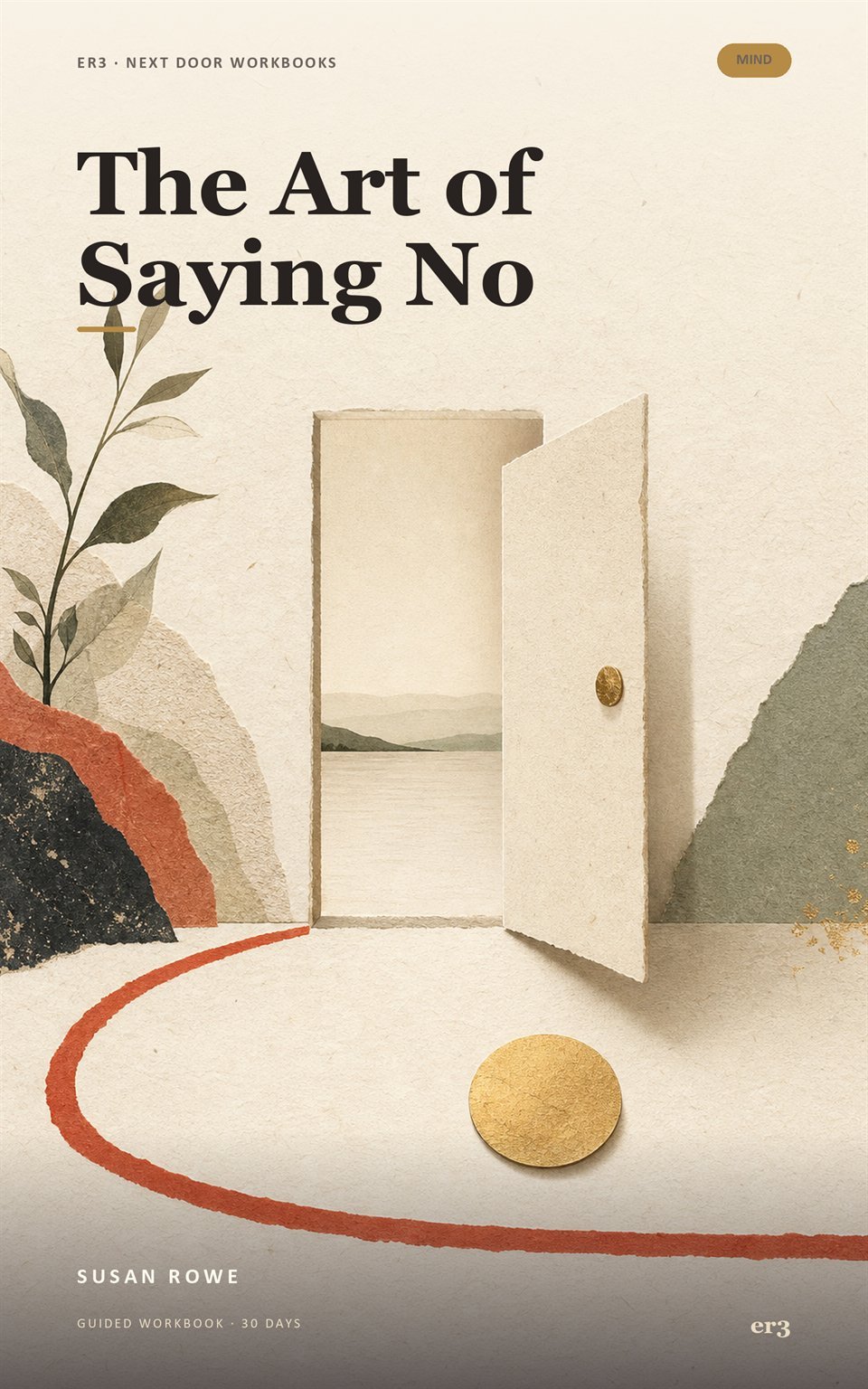
$17The Art of Saying No
THE WORKBOOK

So I turned those thirty days into a book

It's the apprenticeship, laid out day by day: the breath before the yes, the sentence with nothing stapled to it, the nerve to hold it when they push. Room to write by hand, one small step a night. Not a cure for a lifelong reflex β€” just the practice of catching the \"yeβ€”\" before it costs you another Saturday.

  • 30 days, one at a time β€” no overwhelm.
  • One realistic step a day, with room to write.
  • Written by someone who lived it, not a cold manual.

Less than the physio bill one un-said no already cost me β€” and a fraction of a single therapy session.

βœ“ 30-day guarantee β€” full refund, no questions asked

Secure checkoutInstant downloadFill-in workbook30-day guarantee

What you get

Everything inside your 30-day workbook

30 days, one at a time

A short, honest read each day and a "your step today" that's always small enough to actually do β€” a breath, one sentence, one favor declined. No productivity sprint, no falling behind.

A pact you sign on day one

Not a contract with anyone else β€” one with yourself, in your own handwriting, that a no is allowed to walk in alone, without the paragraph of apology trailing behind it.

Day 27, the honest one

A gentle, clear-eyed day that names when boundary trouble runs deeper than people-pleasing β€” old fear, old debts β€” and points you toward real, professional help. No pretending a workbook is enough for everything.

Room to write by hand

Daily prompts with actual space to answer in ink β€” because getting the reflex out of your head and onto the page is half of catching it. A few lines a night, no one grading you.

A printable PDF you keep

Yours to print and mark up, read at the kitchen table, dog-ear and spill coffee on. The same thirty pages I wrote by hand, in a format you can start tonight.

What one day inside looks like

DAY 7 Β· AN ORDINARY DAY
  • A short, two-minute read that doesn't lecture you.
  • One single step for today. Small on purpose: it fits your worst day.
  • Room to write it in your own hand. Your words, your pace.

How the 30 days work

Week 1

Seeing the automatic yes β€” and where it learned to be so fast

Week 2

The three tools: the pause, the no with no excuse, the sentence for people who push

Week 3

Taking it into the hard ones β€” your mother, the coworker, the crisis-only friend

Week 4

Living from your own calendar instead of everyone else's

Who wrote this

S

By Susan Rowe

Susan Rowe spent twenty years as the person everyone in the office asked first, and still keeps a physiotherapy bill in a drawer to remind herself what a yes can cost. She wrote this as the woman she actually is β€” one who still catches the \"yeβ€”\" some days, but now notices it the same afternoon instead of ten years later.

Our deal with you

  1. We won't tell you that in 30 days you'll be cured. It doesn't work that way, and you know it.
  2. No invented testimonials, no fake countdowns, no "only 3 left".
  3. If you open the workbook and it doesn't speak to you, I'll refund you. No questions, for 30 days.
This is companionship, not therapy, and doesn't replace help from a professional. If you or someone is in danger, get help: in the US, 988 (crisis) and, in an emergency, 911. If there's abuse, the National Domestic Violence Hotline 1-800-799-7233. And if the pain has become constant, talk to a psychologist.

Frequently asked questions

Is this therapy?
No. It's one woman's honest experience and a gentle 30-day companion, not treatment. It sits beside your life, not in place of a professional. Days 20 and 27 are frank about when boundary struggles run deeper than people-pleasing, and where to find real help.
I hate confrontation. Is this going to make me be blunt or rude?
No. This isn't about becoming harder. It starts with a small pause and a clean sentence β€” no big showdowns, no scripts that don't sound like you. You stay warm. You just stop abandoning yourself to keep the peace.
Will 30 days actually change a lifelong habit?
It won't hand you a cure, and I don't pretend it does. What it gives you is practice: seeing the automatic yes, catching it a little sooner each time. Small, doable, one day at a time β€” you keep the parts that fit and build from there.
Do I have to write things down?
There's room to, and it helps β€” a few lines a day, by hand, with a small "step for today" that's always small enough to actually do. But no one's grading you. Some days you'll just read and think, and that counts too.

Start today. One day at a time.

Every honest no is a yes to your own life.

βœ“ 30-day guarantee β€” full refund, no questions asked

Get the free 1-page guide

Leave your email and I'll send it right now. Β«The 5-Minute Brain DumpΒ»

I'll send you the guide and, now and then, something that might help. No spam; unsubscribe anytime.

This is companionship, not therapy, and does not replace help from a professional.

$1730-day guarantee β€” full refund, no questions asked
I want the workbook