A 30-DAY CHALLENGE

You heard yourself yell at your child β€” and it was your mother's voice, word for word. The exact phrase you swore you'd never say came out of your mouth, and something in you went cold. You love them more than anything. So why do you keep reaching for the same hands that hurt you?

For the mother or father who catches the old anger rising and is terrified of handing their kids the very thing that marked them.

The words came out before I could catch them. Here's what I did after.↓

"You did that on purpose. You alwaysβ€”" and I stopped, because that was her voice, not mine. Word for word. The same sentence she used to aim at me, coming out of my mouth, pointed down at a four-year-old with a marker in her fist.

She hadn't done it on purpose. She'd drawn on the wall because she was four and the wall was there. I knew that. I said it anyway. And my daughter went quiet the way I used to go quiet. Small. Waiting to see how bad it got.

I want to say I stopped there. I didn't. For a long time I did the thing you probably do. I tried to be a good mother by clenching my teeth. I swallowed it. The mess, the whining, the third time she called my name in an hour. I held it down all day like a lid on a pot, and then some ordinary evening, over nothing β€” a spilled cup, shoes on the wrong feet β€” the lid came off and I heard a voice fill the kitchen that I hated. It was hers. It was mine. I couldn't tell anymore.

Then the part no one sees. Lying in the dark after she was asleep, running her face on a loop. Deciding I was the worst thing in her small life. Promising the ceiling that tomorrow I'd be soft, and not believing me.

"You keep saying sorry," I told the ceiling. "So say it and then do it differently." I couldn't do the second part yet.

And I lied to myself to get out of bed. I told myself I wasn't like her. A raised voice isn't a raised hand, I said. She's little, she won't hold onto this. But I held onto everything. I was living proof you hold onto everything. That was the whole thing β€” I remembered all of it, and my hands still reached for her tools like they were the only ones in the drawer.

The bottom came in the bath. Weeks after the wall. She'd splashed the whole floor and I'd barked, and then I reached across her to grab the shampoo β€” moved my arm fast, over her head. And she flinched. Ducked. Pulled her shoulders up to her ears and waited for a hand that was never going to fall. She didn't even know she'd done it.

I knew. Because I know that flinch from the inside. I invented it, once, in a bathroom that wasn't this one, thirty years ago. And here it was again, wearing her face. I'd handed it to her without noticing. She'd learned to brace, and she'd learned it fromβ€” From me. I made myself finish the sentence this time.

There was no wise stranger. No line from a book that turned the light on. It was just me, later that same night, hearing myself in my head β€” that cold flat drop my voice does right before it goes off, the exact temperature of hers β€” and finally understanding it wasn't a temper. It was a groove. Worn in by someone else, walked by me for forty years, and now I was walking my kid down it in her socks.

I couldn't hand her a calm I'd never been given. That part was true and it stayed true. But I could learn it out loud, in front of her, with my mistakes showing. Slowly. One reaction at a time.

So I found the three seconds. Just three β€” long enough for the old voice to lose the grip on my throat. I learned to leave the room instead of aim at the room. To drop my voice on purpose exactly when everything in me wanted to raise it. I wrote it down at night, by hand, because the loop got quieter on paper than it ever did loose in my chest.

I still slipped. I slip now. The difference is what I do after. I get down on the floor, to where her eyes are, and I say it plain: that was mine, not yours, and I'm sorry, and it's not your job to carry it. Nobody ever knelt down to me. So I kneel down to her, and the flinch has stopped coming, and some nights I catch her reaching back.

The chain doesn't break with a big gesture. It breaks in a small kitchen, one held tongue at a time.

I put it all in here because I know that kitchen. I know the ceiling promises and the terror that she'll remember you the way you remember them. And I know shame just runs the machine faster. So I made the thing I went looking for and couldn't find β€” not to put anyone on trial, not even her, but to learn, one plain day at a time, how to hold this thing so it stops in my hands instead of passing through them.

Does this sound like you?

You hear a phrase leave your mouth and it's word for word what wrecked you.
You lose it, then lie awake hating yourself for it.
You promised you'd be different, and some days you're not.
You're scared your kids will remember you the way you remember them.
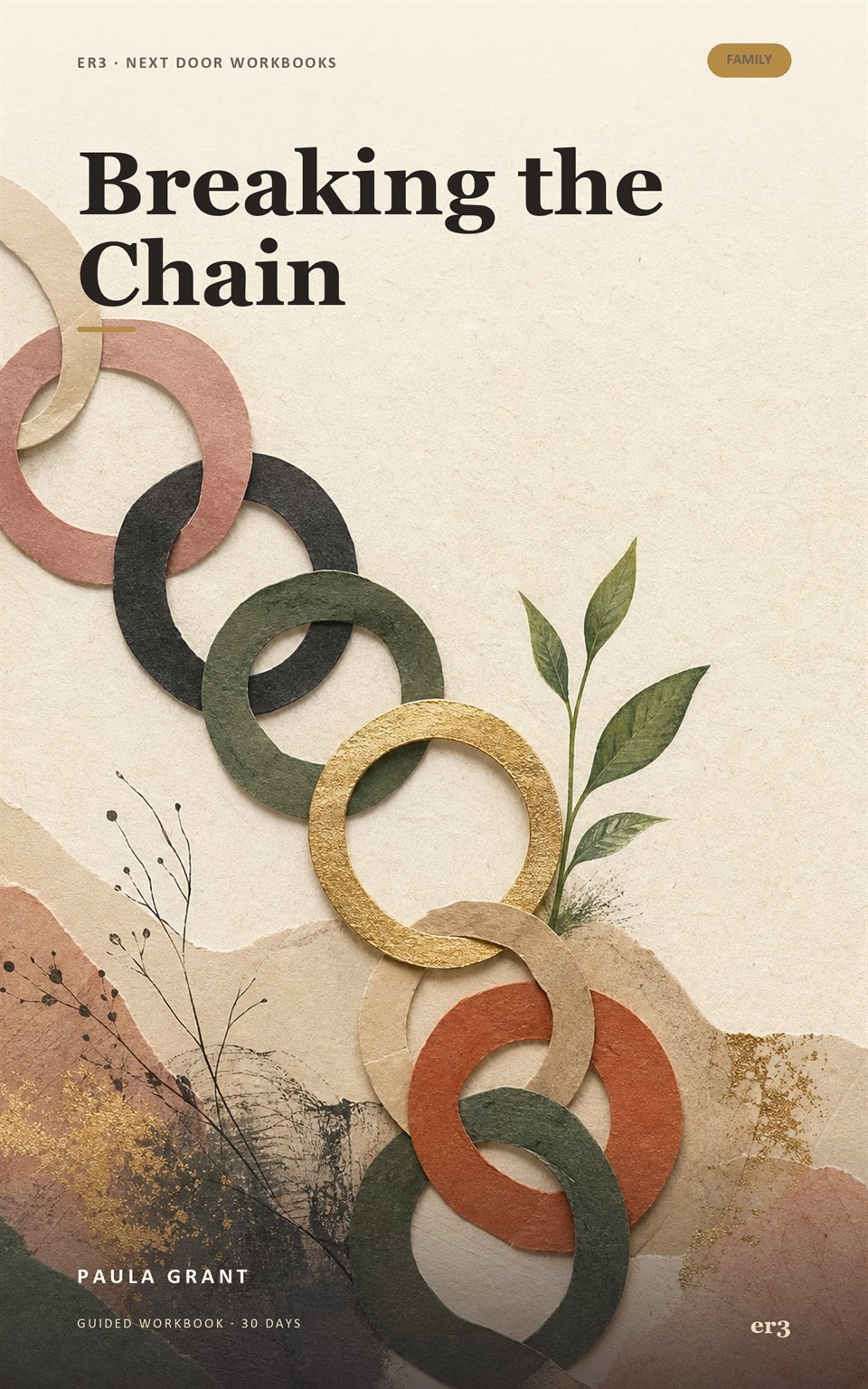
$17Breaking the Chain
THE WORKBOOK

So I built the thing I went looking for and never found

Thirty days, one at a time, for the parent who hears the old voice drop cold and is scared of where it lands. Not a place to punish yourself β€” a place to catch the reaction, kneel down and repair it, and wear a new groove your kids can walk instead.

  • 30 days, one at a time β€” no overwhelm.
  • One realistic step a day, with room to write.
  • Written by someone who lived it, not a cold manual.

Less than a single session with the family therapist you keep meaning to call β€” and it's yours to reopen every night the old voice rises.

βœ“ 30-day guarantee β€” full refund, no questions asked

Secure checkoutInstant downloadFill-in workbook30-day guarantee

What you get

Everything inside your 30-day workbook

30 days, one page at a time

Each day: a short honest read, one small thing to try before bedtime, and a blank space to write the day out by hand. No streak to keep, no app, no sprint β€” the loop just gets quieter on paper.

The pact you sign

A page you fill in and put your name to β€” the parent you're choosing to be β€” for the nights your head is loud and you need to remember who decided this, and when.

Repair, spelled out

You will slip. This shows you exactly how to go back, get down to their height, and mend it β€” the thing no one ever did for you β€” instead of lying awake drowning in it.

Day 27, the honest one

A plain page that tells imperfect, yelling-and-sorry parenting apart from real harm at home, and points you to help if that line is the one you're standing on.

Yours to keep, printable PDF

Read it on a screen or print it and write in the margins. It's a workbook, not a lecture β€” it's built to be scribbled in.

What one day inside looks like

DAY 7 Β· AN ORDINARY DAY
  • A short, two-minute read that doesn't lecture you.
  • One single step for today. Small on purpose: it fits your worst day.
  • Room to write it in your own hand. Your words, your pace.

How the 30 days work

Week 1

See the groove you were handed β€” the exact words, the cold drop in the voice, whose they were β€” without putting anyone on trial

Week 2

Catch it in the heat: the three-second gap, leaving the room instead of aiming at it, dropping your voice on purpose

Week 3

Kneel down and repair β€” how to say 'that was mine, not yours' so a slip becomes the lesson

Week 4

Wear the new groove: the small daily moves that stop the chain in your hands instead of passing it on

Who wrote this

P

By Paula Grant

I'm Paula. I teach a Tuesday-night pottery class in a community-center basement, and the first thing I tell beginners is that the clay remembers every place your thumb pressed too hard β€” which is maybe why the day my daughter flinched at me, I understood it in my hands before my head caught up. This is the workbook I went looking for that night and couldn't find.

Our deal with you

  1. We won't tell you that in 30 days you'll be cured. It doesn't work that way, and you know it.
  2. No invented testimonials, no fake countdowns, no "only 3 left".
  3. If you open the workbook and it doesn't speak to you, I'll refund you. No questions, for 30 days.
This is companionship, not therapy, and doesn't replace help from a professional. If you or someone is in danger, get help: in the US, 988 (crisis) and, in an emergency, 911. If there's abuse, the National Domestic Violence Hotline 1-800-799-7233. And if the pain has become constant, talk to a psychologist.

Frequently asked questions

Is this therapy?
No. This is one parent's lived experience, written to walk beside you β€” not a treatment and not a substitute for a professional. If the pattern runs deep, or there's real harm at home, a good family therapist is worth every penny, and Day 27 helps you know when to reach for one.
I already lose my temper and feel awful. Won't this just pile on more guilt?
The opposite. Guilt keeps the cycle spinning. This book is gentle with you on purpose: you can't give your kids calm you've never been shown, so first you learn to stop punishing yourself β€” then the change actually holds.
What if I've already messed up and my kids are older?
It's not too late. Children remember repair as much as rupture. A parent who comes back, owns it, and does it differently teaches something powerful β€” and the book shows you exactly how to have that conversation, whatever their age.
Do I have to blame my parents to do this?
No. You can understand where a pattern came from without hating anyone. The point isn't a verdict on them β€” it's a decision about you, and about the small hands that come after.

Start today. One day at a time.

The chain breaks in the hands that decide to hold it differently.

βœ“ 30-day guarantee β€” full refund, no questions asked

Get the free 1-page guide

Leave your email and I'll send it right now. Β«5 Phrases to Set a Boundary Without Burning the BridgeΒ»

I'll send you the guide and, now and then, something that might help. No spam; unsubscribe anytime.

This is companionship, not therapy, and does not replace help from a professional.

$1730-day guarantee β€” full refund, no questions asked
I want the workbook